Outdoor Perimeter Hydrant System
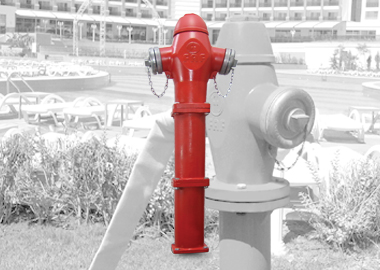
Outdoor Perimeter Hydrant System
External fire hydrant systems are designed to allow firefighters to access water quickly and safely during an emergency.
The system must be planned to cover the building perimeter and ensure that fire trucks can approach and connect easily.
A properly designed hydrant system provides an essential external water source and plays a key role in fire control and containment.
Flow and Pressure Requirements
The minimum design flow rate for hydrant systems should be 1900 L/min, and this value must be increased based on the building’s hazard classification and relevant standards.
The required operating pressure at the hydrant outlet must be at least 700 kPa to ensure proper equipment performance.
The duration of water supply and reservoir capacity should be defined according to local codes and international standards such as NFPA 24.
Hydrant Spacing and Location
Hydrant spacing varies according to the risk level of the area:
-
Very high risk: Maximum 50 m apart
-
High risk: Maximum 100 m apart
-
Medium risk: Maximum 125 m apart
-
Low risk: Maximum 150 m apart
Typically, hydrants should be placed 5–15 meters away from the protected buildings to ensure easy access and maneuverability for fire trucks.
Piping and Diameter Selection
Where possible, the hydrant network should be designed as a closed ring main to maintain system pressure stability.
If a ring layout is not feasible, the minimum main pipe diameter must be 100 mm, determined by hydraulic flow calculations.
All pipes must comply with EN 545 or equivalent standards for ductile iron pipes and be resistant to corrosion and external impacts.
Compliance and Maintenance
All hydrants must meet EN 14384 (Above-Ground Fire Hydrants) standards.
Each section of the network should include shut-off valves (above or below ground) to enable easy maintenance or isolation without disrupting the entire system.
Valves must be easily accessible and protected against physical damage and freezing.
Installation Requirements
An external hydrant system is mandatory in the following cases:
-
Buildings with a total floor area exceeding 5000 m²
-
Isolated facilities or industrial zones
-
Remote areas where fire truck access is limited
In such locations, above-ground hydrants, fire ponds, or dedicated storage tanks must be installed to ensure an adequate firefighting water supply.
Engineered by MYMEC GROUP
At MYMEC GROUP, we design and implement EN 14384 and NFPA 24 compliant fire hydrant systems for industrial and commercial sites.
Our engineering process includes hydraulic flow modeling, network design, pressure testing, and on-site commissioning.
We aim to deliver durable, high-performance hydrant networks that guarantee effective external fire intervention for every facility.